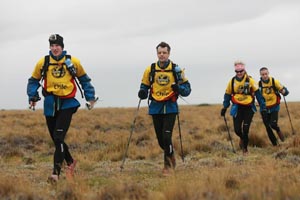
 The ninth edition of the Wenger Patagonian Expedition Race will take place on the edge of the world’s third largest icefield in the stunning fjordland region of Chilean Patagonia – and race organisers Nomadas are aiming to break their record of 14 competing nations for the next event in February 2011.
Places are filling up fast, with a maximum of 15 available due to the event’s self-imposed environmental and logistical limitations, but Briton Bruce Duncan, two-time winner of the race with team Helly Hansen Prunesco, has already signed up to return for a third time in 2011, racing for Team Adidas TERREX.
When he first competed, in 2009, he had never done anything longer than a weekend race but here he explains why the lure of Chilean Patagonia is drawing him back again – and why those who might be keen but nervous about taking on the challenge should get out there and give it a go…
Q: Why do Patagonia?
BRUCE DUNCAN: There are countless adventure races all around the world, but this one really stands out. It’s in pretty much the most remote place in the world that you can get to, apart from Antarctica, and it’s amongst stunning scenery. It’s a proper adventure, getting out there in the middle of nowhere for five, six, seven days.
Q: Before you did your first race in 2009 you had never done anything like it, what were your fears and how did you overcome them?
BD: I’ve always aspired to do a long adventure race having seen them on television and although I was in a team that was doing long races I hadn’t done one up to that point. I went in eyes partially open to what was going to be ahead and prepared as well as I could. I was very fit at the time, which helped, but I only had a couple of weeks notice so I didn’t have great preparation. It was very hard, but given the training and races I had done before, I realised it’s no harder than a weekend race – it just goes on longer. It’s all a state of mind, anything is possible if you have a good team around you, and with all the adventure you are having it makes it seem a lot easier.
Q: What experience should someone coming into this have?
BD: You need to have experienced being right at your limit so if you’ve only done a five-hour race go out and do a 24-hour race – there’s plenty of them around – just to experience the sleep deprivation and the mindset you have to get into. Get out, do plenty of kayak training, plenty of running long distances and get out on the bike because there are some long miles to cover on the bike.
Q: How prestigious is the race out of all of them?
BD: Everyone knows about it because it is a true adventure race, unlike all the others. It does stand out on its own. A lot of teams won’t do it because of the lack of prize money but a lot of teams want to do it because of where it is. It’s the Wenger Patagonian Expedition Race. It’s an awesome race to do. It’s an awesome place to go. And it really is a challenge to yourself, rather than against the other teams.
Q: What are the costs of doing it – is it really that expensive?
BD: It’s not ridiculously expensive. The flights can be, but once you’re there it’s not too bad. The thing is, if you tried to do that kind of expedition with an organised company on a trekking trip, to the Himalayas for instance, the costs would be way, way more, so for that it’s actually quite a bargain! And also it’s the fact that you are going to places that literally only a handful of people have been before. There’s so few places in the world where you can do that, less and less as time goes by, so it’s incredibly good value for money.
Q: How do you section up the experience in terms of remoteness, adrenaline, exhaustion, beauty and so on?
BD: It’s a real mixture of everything. The event registration is in a reasonable sized town, but you can tell even there how remote it is from the rest of the world. Then you set off and both years I have raced there the start has been pretty dramatic, the weather’s been up a bit, the adrenaline is going from the world go, and it’s stunning scenery all around you. You’re soon in the middle of nowhere and when you get into the mountains there’s not a trace of human life out there, no buildings, no paths other than animals, and it really is properly out there.
Q: What about people who have raced in more populated areas – what confidence can you give to people who might fear throwing themselves into this remote experience?
BD: The entire race is designed so there is support for the racers. People know where you are and there are ways to get you out if something does go wrong. But as far as being in the middle of nowhere it’s no worse than walking in the hills in the Lake District in the UK – if something goes wrong there, you’re pretty much in the same position. It’s just a case of being prepared, having the right kit, the right food, and knowing mentally that it is going to be challenging but embrace it. The kit you have to carry is sometimes heavy, but it’s there for a purpose. You’ve got a tent, a sleeping bag, food for however many days, and there is plenty of safety equipment. All teams have a satellite phone and you have a GPS you can break out too so if you need to get in touch with anyone you can tell exactly where you are. There’s a lot of safety inbuilt.
Q: What would you say to anyone thinking ‘oh, can I, can’t I…’?
BD: Yes you can. Anyone can, within reason. You need to train, it’s not easy, you can’t just turn up, you need to get some good training in and get your skills up in a kayak, and just remember the vast majority is a state of mind. If you can keep mentally pushing on, as I discovered on the first year, you can still keep on going.
Q: And what highlights give you a reason to go back?
BD: Some phenomenal highlights. This year, swimming the river was crazy! It looked pretty scary but we got across and it was fine – and it was a real highlight for us and brought us together as a team. Trekking through the Darwin Range, just being able to stand there and look at these amazing mountains and at night, crystal clear skies, absolutely beautiful. Crossing the finish line, whether you’ve come in first or last, you’ve finished, and that’s huge. The sense of personal achievement is absolutely phenomenal. And the feeling of going to somewhere people haven’t been – it’s very special.
AND…
Stjepan Pavicic, a trained geologist and passionate environmentalist, set up the Wenger Patagonian Expedition Race to promote and protect the pristine beauty and remote wilderness of his homeland in Chilean Patagonia. The race is now an internationally recognised event and will run its 9th edition in February 2011.
Q: What made you set up the Wenger Patagonian Expedition Race?
Stjepan Pavicic: “My motivation to create the race came initially from my passion for nature, my love of sports and the appreciation for my place of birth. It was an opportunity to create a totally unique, global and authentic sporting event that would support sustainable business development and conserve Chilean Patagonia – one of the few truly wild places remaining on earth. I also wanted to create a life changing experience for the racers.”
Q: What will the route be for the 2011 race?
SP: “The route is always a closely guarded secret – we won’t tell racers where it will be until 24 hours before the start – but I can give a few hints. For many years I have dreamed of taking the race closer to the ice field, the third biggest area of ice in the world after Antarctica and Greenland, and there is a very big fjord region with some incredible scenery and it would be nice to go there. But there are many spectacular areas to explore in Chilean Patagonia, so let’s see…”
Q: Who can enter?
SP: “The race is so unique that whatever experience you have you are unlikely to have experienced something like this – so anyone who has a reasonable level of fitness can register, as long as they can pass the relevant safety criteria. The rules can be found on the official website.”
Q: How can people enter?
SP: “People can sign up on the website to apply. There is a nominal charge for entry and there are also skill requirements for certain disciplines. We strictly keep the race field to a maximum of 15 teams, so unfortunately not everyone who wants to race can get a place – and with eight of the 2010 teams keen on coming back next year we are already seeing quite a high demand for those spots!”
Q: How else can people get involved?
SP: “We are always looking for support to help the race grow, from companies who want to promote their products in spectacular and tough terrain to graduates or experienced professionals who want to further their careers working to support the environment. Anyone interested in getting involved should email the race on info@patagonianexpeditionrace.com or work@nomadas.cl”
Q: What are your aims for the future?
SP: “This is an exciting time for us. The reputation of the race is growing year on year. It is now globally recognized as one of the top endurance challenges on the planet, it is aligned with Chile’s Olympic association and it has a growing number of excellent supporting partners. All this helps us work towards our ultimate goal, which is to create a spectacular, challenging truly wild sporting spectacle and to use it help protect the environment in this beautiful region.”
Official Race Website: www.patagonianexpeditionrace.com