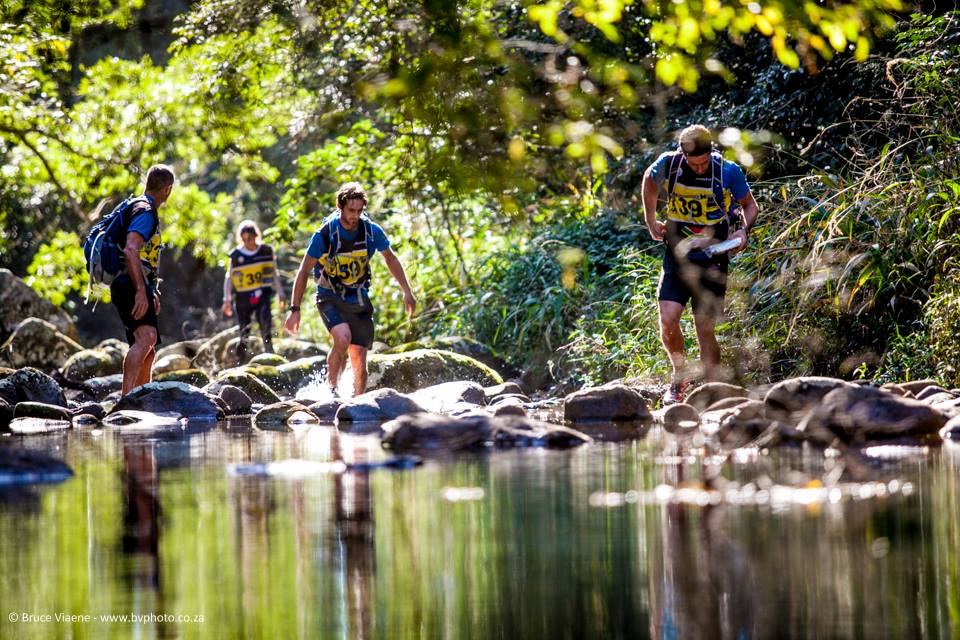
Our (media) day started really early so that we could drive through to the canyon to catch the front teams emerging. Course director Stephan Muller had predicted that we’d see them any time between 09h00 or 10h00 – closer to 10h00.
The canyon
Boom! It’s 10h15 on Monday morning and we’re deciding what snacks and warm tops to put into our backpacks to take to CP16 (canyon exit) when Chris Forne and Stuart Lynch (Seagate) appear at the top of trail metres to my left.
Excitement! Asking how they were doing Chris mentioned that his feet were quite sore. After almost 80 kilometres of trekking this was hardly surprising. I didn’t realise that this would be a recurring theme, especially as darkness fell.
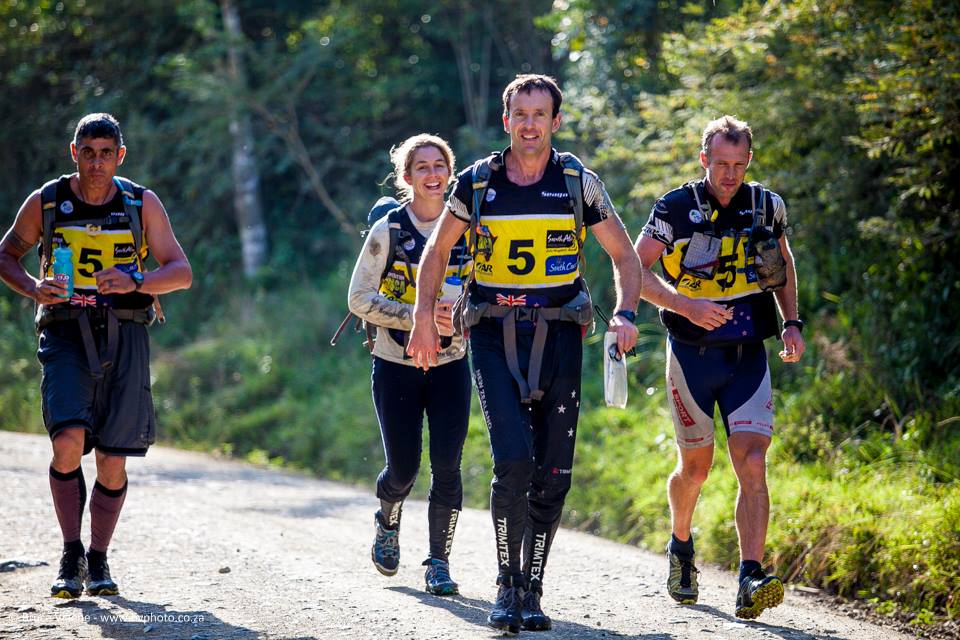
Waiting…
And then we waited. And waited. And waited. Live online tracking showed teams to be not far from us, race HQ let us know that teams were close… but time and distance down there are not relative to each other.
Having done this same canyon little more than 10 years ago in an adventure race – with Heidi and Stephan (them racing in a team and me on the tv crew hiking with the team) I can attest to its difficulty.
Water flows gently (not a gushing river) down the canyon, which has huge, steep sides where they enter it. There are bigger rocks and pools higher up. Throughout they’re scrambling on rounded, water-worn rocks. Many are slippery. Sliding, stumbling and falling is inevitable. During the day slower sections will probably elicit a 1km/hr pace… At night, I’d bank my money on 500m/hr, which is what we did all those years ago – or slower! This is a very physical section.
Almost three hours later we saw our next team – Painted Wolf.
“John and I have never messed up navigation so badly,” says Mark Collins in response to my question about the navigation on the hike. “I hope you weren’t following our track online.”
In short, they misjudged a canyon, thinking they were somewhere they were not. They seemed to think that they’d already crossed the big canyon on their map – but it was just a smaller one. And then 30-minutes later they found the big one – a gaping black chasm ahead. But they were in the worst possible place to cross it and ended up travelling too close to the coast. The way Mark describes it their route was less ‘as-the-crow-flies’ and more ‘all-over-the-place’.
Nonetheless, it still worked out ok for them and they passed two teams in the canyon.
“We saw one (Tecnu) and heard another,” Marks says.
And so it was that we saw Tecnu and Haglofs Silva appear not too long afterwards.
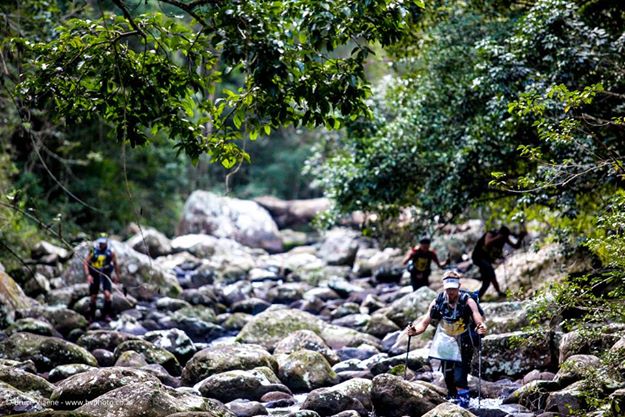
I ask Tecnu how the trek has been.
“Fine until now,” says Mari Chandler referring to the canyoning. “We’re glad to be out of there.”
I always maintain that canyoning is super fun for the first hour, tolerable for the next hour and ‘I-want-to-get-out-of-here’ for every hour thereafter. My theory holds.